
When we dream of Japan, we often picture the sleek nose of a Shinkansen bullet train slicing through the countryside, connecting gleaming megacities in a blur of hyper-efficiency. It’s an iconic image, a symbol of the country’s futuristic pulse, and a journey many travelers aspire to take. My own trip to Tokyo, however, started down a different track.
Instead of the famous bullet train, a friend and I decided to take the slow route: a marathon journey from the Nagoya area to the capital via a network of local trains. What followed was a day of constant transfers, long waits, and unexpected challenges. But as is so often the case, the most profound travel lessons weren’t waiting for me at the destination; they were found in the detours and difficulties along the way.
Takeaway 1: The Real Difference Between a Bullet Train and a Local Train is Five Hours and a World of Patience
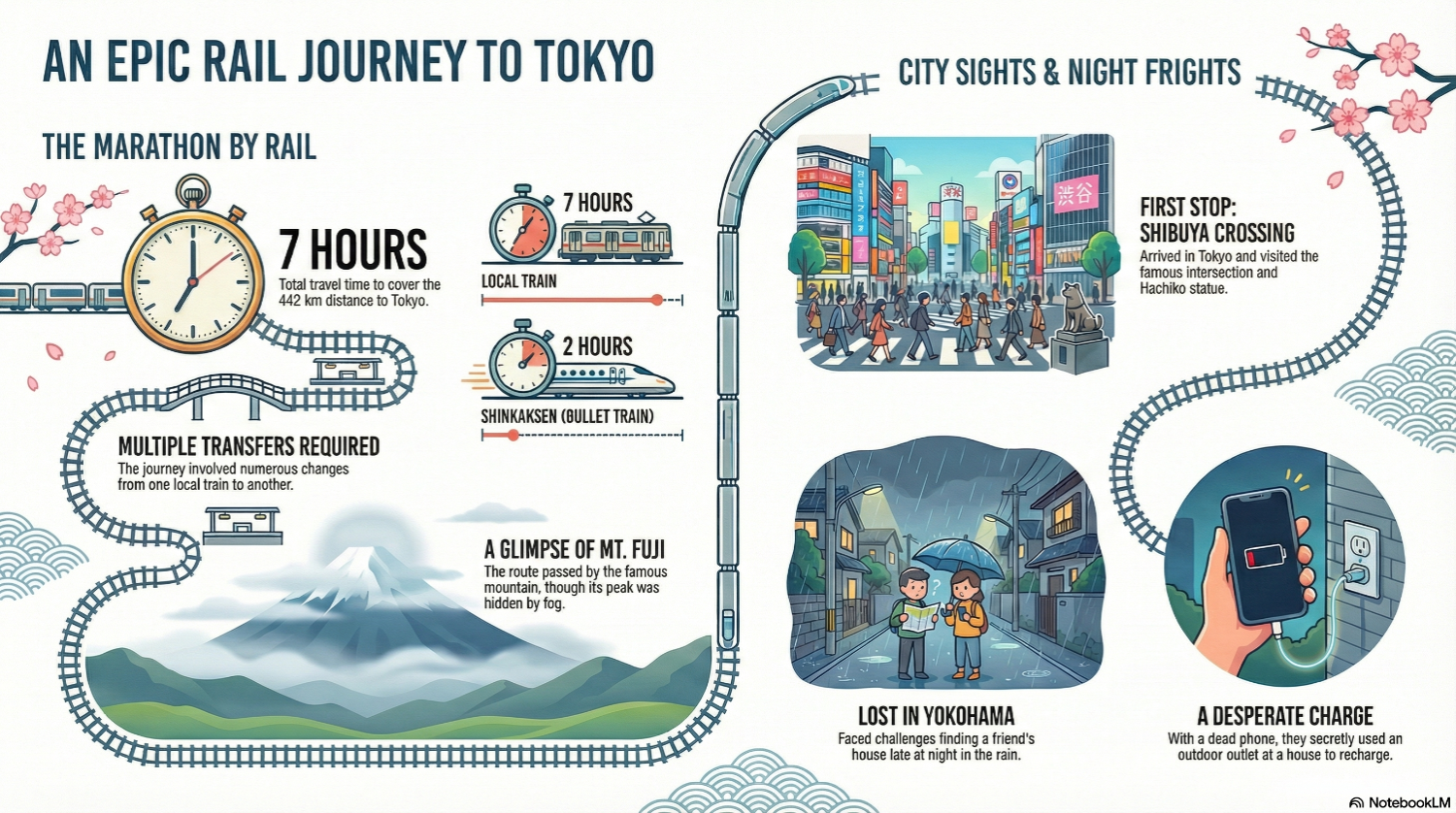
The journey from the Nagoya area to Tokyo is approximately 442 kilometers. By Shinkansen, this trip is a masterclass in speed, taking just 2 hours. Our chosen path, the local train network, took 7 hours.
This wasn’t a single, long ride. It was a grueling relay race of rail travel. We’d ride for about an hour, get off, find our next connection, board a different train, and repeat the process again and again. I, however, had no idea what was in store. My friend Bayaraa, on the other hand, had made this trip once before and must have known exactly the test of endurance we were facing. His knowing patience stood in stark contrast to my growing surprise. Our journey became a powerful lesson in the trade-offs every traveler makes. We saved money, but we paid for it in time, experiencing the country’s vast infrastructure at a human, and sometimes frustrating, pace.
Takeaway 2: In Japan, Napping on the Train Isn’t Laziness—It’s a Strategy
As the hours passed, I noticed a common sight in every carriage we sat in: fellow passengers, from students to professionals, were sound asleep. My travel companion, tired from an early start, did the same. It soon became clear that this wasn’t just about catching up on lost sleep. It was a cultural observation.
“I realized that in Japan, with their high value on time utilization, it’s very common for people to sleep on the train.”
This small detail speaks volumes about the rhythm of daily life in Japan. In a society that places an immense premium on efficiency and productivity, even the daily commute is an opportunity to recharge for the next task. The train nap is not a sign of laziness; it’s a finely tuned strategy for managing the relentless pace of a demanding world.
Takeaway 3: Even Iconic Landmarks Are Not Immune to Change
At one point, our route took us past the legendary Mt. Fuji. Hopes of seeing its perfect, snow-capped cone were dashed by a thick blanket of fog that completely obscured the summit. But the view I missed was replaced by a piece of information that was far more impactful.
I learned that the “permanent” snow I had always associated with Mt. Fuji is no longer permanent. Due to the effects of global warming, the iconic snowcap now melts away entirely during the summer months. It was a sobering moment. This timeless symbol of Japan, an image that feels as eternal as the mountains themselves, is actively being changed by our modern environmental challenges. The postcard view is no longer a guarantee.
Takeaway 4: When You’re Lost, Wet, and Your Phone is Dead, True Resourcefulness Kicks In
After our 7-hour train ride, the adventure was far from over. We continued on to Yokohama to meet a friend, arriving late at night. And that’s when everything started to go wrong. We were lost, and the phone containing our only map was about to die. Just as the battery warning flashed, a cold rain began to fall.
Soaked and shivering, I worried especially for our female friend; it was one thing for us two guys, but the cold seemed especially hard on her. Disoriented, we spotted a potential lifeline: an outdoor electrical outlet on the side of a random person’s house. Desperate, the three of us huddled under the eaves and secretly plugged in our phone. It was a bizarre moment, a mix of genuine fear—what if the owner came out and found us?—and a strange sense of fun. Hiding from the rain, borrowing a few minutes of electricity, felt like a tiny, ridiculous adventure. And then, in the middle of our nervous waiting, a very rare animal appeared in front of us, a moment of strange magic amid the chaos. Eventually, the phone gained enough power to show us that our friend’s house was just a short distance away.
These are the moments that truly define a journey. Not the ones you plan, but the ones that find you—a cocktail of desperation, absurdity, concern for your friends, and a sudden, inexplicable brush with wonder. It’s not just about resourcefulness; it’s about experiencing the entire spectrum of what it means to be far from home and thrown back on yourself.
Conclusion: What Defines a Journey?
The bullet train would have been faster, easier, and more comfortable. We would have arrived in Tokyo feeling fresh, with a perfect photo of Mt. Fuji and a fully charged phone. But we would have missed the real journey. We would have missed the quiet lessons in patience learned between train cars, the cultural insights found in sleeping commuters, the shocking truth of a snowless mountain, and the strange, rain-soaked adventure of borrowing electricity under the gaze of a mysterious creature.
It proved that the most valuable travel experiences are often the unscripted, uncomfortable, and surprising ones. They are the moments that reveal not just the character of a place, but the depth of your own. It leaves you with a question: When you travel, is it the destination you’re seeking, or the unexpected person you become along the way?